The Challenge
After the COVID-19 pandemic, the number of remote workers increased dramatically, yet digital nomads continued to face significant challenges.
- 13.5% of EU workforce working remotely by 2021 (doubled from 2019).
- Key pain points identified: finding workspaces and meeting peers.
How might we create a solution that addresses both professional and social needs of digital nomads?
The Solution
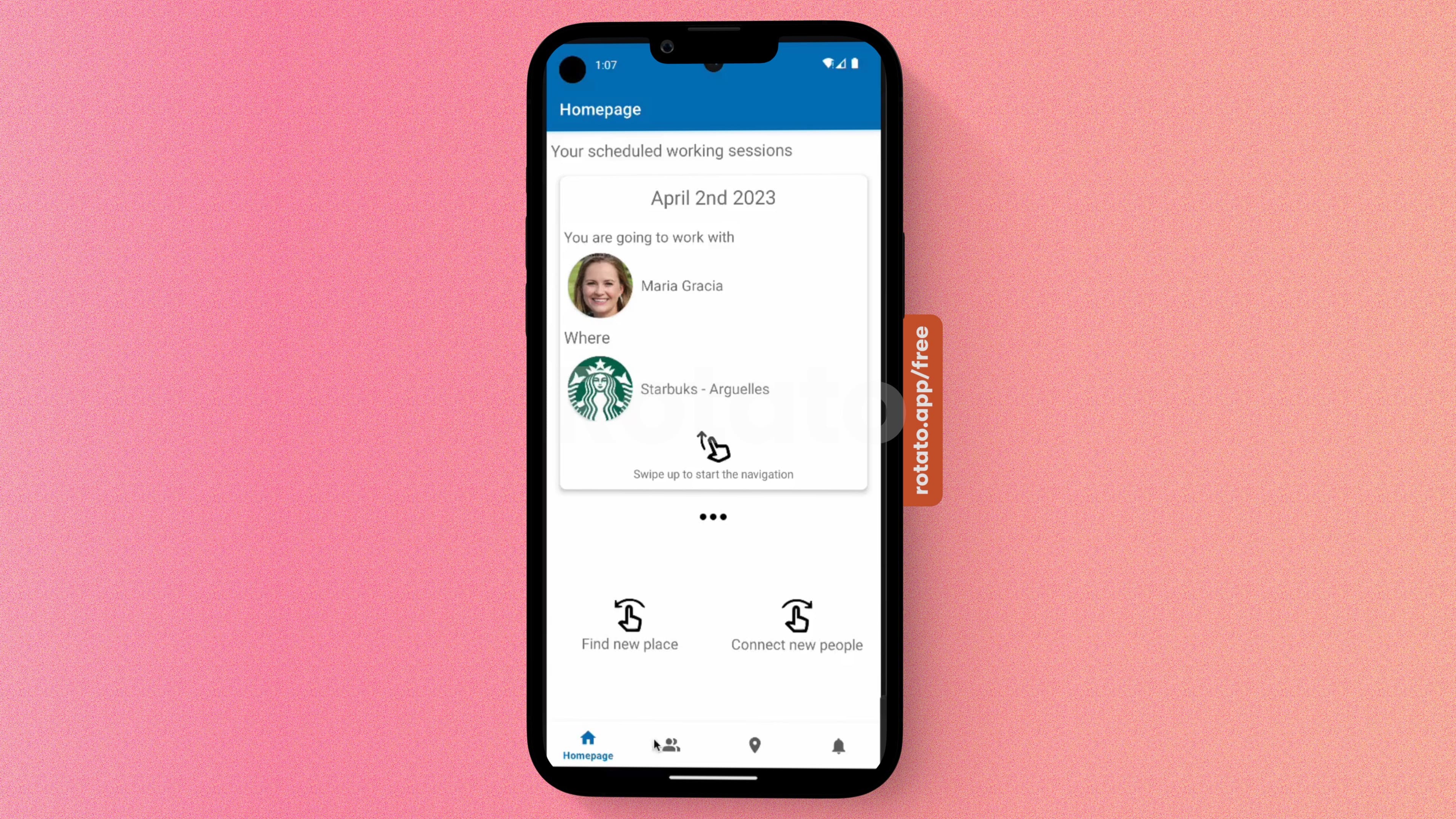
A mobile application that helps digital nomads find ideal workspaces and connect with like-minded professionals.
Key Features
- Workspace Discovery: Find ideal workspaces based on personalized preferences.
- Community Building: Connect with like-minded professionals in your area.
- Meetup Organization: Schedule and join in-person professional gatherings.
- Workspace Reviews: Community ratings on WiFi, noise levels, and amenities.
My Role
As the User Researcher & UX Engineer, I led the entire user-centered design process.
- User Research: Semi-structured interviews, observations, and data analysis.
- UX Design: User journeys, task flows, and paper prototypes.
- Hi-Fi Development: Android implementation and usability testing.
Research Process
We recruited 9 participants at Starbucks Madrid, representing diverse digital nomad profiles (Students, freelancers, and corporate employees). We conducted 24 questions in a semi-structured interview format exploring needs and frustrations.
Lo-Fi Prototyping
We developed two distinct paper prototypes to test different interaction approaches with users.
- Menu-Based Prototype: Traditional form-based interface with structured navigation.
- Direct Manipulation Prototype: Interactive map-based interface with gesture controls.
Testing Methodology
- 15 participants using "thinking aloud" method.
- Metrics: task time, click count, error rate.
- SUS questionnaire for satisfaction assessment.
Testing Results
- Direct Manipulation: 78.4 SUS Score (Good Usability).
- Key Finding: Map-based interface resulted in 24% faster task completion on average.
Hi-Fi Prototype & Implementation
We implemented the Android app and tested it with 16 participants at Starbucks Madrid.
- Key Tasks: Finding ideal workspace and connecting with other digital nomads.
- Metrics Collected: Task time, click count, error rate, SUS score, and UEQ results.
Results & Impact
Validated Design Solution
- Final SUS score of 83.6 (excellent usability).
- UEQ showed highest ratings in efficiency and attractiveness.
- 91% of participants successfully completed all tasks.
- User research confirmed the need for location-based nomad community.
Key UX Improvements
- Map-first interface with context-aware filters.
- Quick-access community features for spontaneous meetups.
- Simplified onboarding with progressive disclosure.
- Improved information architecture based on card sorting.
Key Learnings
- User-Centered Process: Value of systematic research-first approach with continuous validation.
- Data-Based Decisions: Importance of both qualitative and quantitative metrics in evaluation.
- Rapid Prototyping: Testing multiple concepts early saves development time and resources.
- Iterative Design: Validation at each stage prevents costly changes later in development.